

RISCTOX Database
Search and consult detailed information about specific chemical substances.
Search other substances
Identification
- Name:
- 4-nitroaniline
- Synonyms:
-
- p-nitroanilina
- nitroanilina (p)
- CAS:
- 100-01-6
- EC/EINECS:
- 202-810-1
- Molecular Formula:
- C6H6N2O2
- International Chemical Safety Card (ICSC):
- 0308
Black list
Substances particularly hazardous to the environment or health
CLASSIFICATION AND LABELLING (Regulation 1272/2008)
Symbols
-
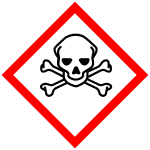
Acute toxicity (oral, dermal, inhalation)
-
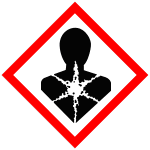
Respiratory sensitisation
Signal word
DangerH Phrases
-
H311 : Toxic in contact with skin
Acute Tox. (Cat. 3 *) : Acute toxicity
-
H301 : Toxic if swallowed
Acute Tox. (Cat. 3 *) : Acute toxicity
-
H412 : Harmful to aquatic life with long lasting effects
Aquatic Chronic (Cat. 3) : Hazardous to the aquatic environment
-
H373 : May cause damage to organs through prolonged or repeated exposure
STOT RE (Cat. 2 *) : Specific target organ toxicity - repeated exposure
-
H331 : Toxic if inhaled
Acute Tox. (Cat. 3 *) : Acute toxicity
Nota C.
Notes
- R.1272-Note C
Specific health risks
Biological Exposure Indices (BEI) ?
Biological limit values (VLB) published by the Spanish National Institute of Safety and Health at Work (INSST). Reference values for assessing the risk of chemical agents by measuring them or their metabolites in biological matrices (blood, urine, exhaled air) of exposed workers.
| Biological indicator | BEI | Sampling time | Notes |
|---|---|---|---|
| Metahemoglobina en sangre | 1,5% de metahemoglobina en hemoglobina total | Final de la jornada laboral (2) | F, I, S |
Occupational Exposure Limits (OEL) ?
Daily exposure limit values (VLA-ED) published by the Spanish National Institute of Safety and Health at Work (INSST). They represent the average concentration of a chemical agent in the worker's breathing zone, measured or calculated in a time-weighted manner for an 8-hour daily working period. (https://www.insst.es/valores-limites-de-exposicion)
| State / Form | TWA (ppm) | TWA (mg/m³) | STEL (ppm) | STEL (mg/m³) | Notes |
|---|---|---|---|---|---|
| — | — | 3 | — | — | vía dérmica, VLBm |
Specific environmental risks
Persistent bioaccumulative and toxic ?
Substances identified as Persistent, Bioaccumulative and Toxic (PBT) according to the criteria of Annex XIII of the REACH Regulation. They pose a special risk of accumulation in the environment and in the food chain.
Restriction/prohibition regulations
Major accident hazards (Seveso) ?
Hazardous substances listed in Annex I of the Seveso III Directive (Directive 2012/18/EU), transposed in Spain by Royal Decree 840/2015. Their presence in industrial establishments in quantities equal to or above established thresholds triggers obligations to implement major accident risk control measures.
List